Wechat
WhatsApp E-mail Top

Search

English

Impact crusher liners

Home > Products > Parts guide > Impact crusher liners

What are impact crusher liner?

Impact crusher liners most include blow bars, impact plates and frame liners.


Blow bars, also known as hammers, are the primary wear components mounted on the rotor of an impact crusher. They serve as the key working element responsible for directly impacting and fracturing the material fed into the crusher. As the rotor spins at high speed, the blow bars strike the incoming rock, propelling it against the impact plates for further size reduction.


As the primary wear part, the condition of the blow bars directly impacts crusher efficiency and product quality. Worn blow bars must be adjusted or replaced promptly to prevent damage to other components and maintain optimal crushing performance. They are designed for relatively quick replacement to minimize downtime


Impact plates are stationary liners mounted on the crusher frame. The material propelled by the blow bars impacts these plates, causing further fragmentation. 


Frame liners are the inner side walls of the crusher housing. They shield the machine body from wear and erosion caused by bouncing rock chips.

Why Gravik impact crusher blow bars?

Why Gravik impact crusher blow bars?

(1) Comprehensive Parts Inventory: We supply a full range of OEM-interchangeable impact crusher liners and wear parts.

(2) Customized Material Selection: A variety of metallurgical options are available for blow bars to match specific crushing applications.

(3) Superior Wear Resistance: Our products are engineered for enhanced durability, utilizing advanced materials to outperform standard liners.

(4) Extended Service Life: We focus on maximizing the operational lifespan of your impact crusher liners.

(5) Competitive Pricing: We offer cost-effective solutions without compromising on quality.

(6) Expert Support: Our team provides professional guidance and recommendations to optimize your crushing efficiency.

Genuine Alternative Spare Parts – Impact Crusher Blow Bars Made by GRAVIK

GRAVIK provides a diverse range of blow bar designs and customized manufacturing solutions, compatible with a wide variety of OEM horizontal impact crushers from leading brands such as NP, CI, Terex, Hazemag, Kleemann, Rubble Master, Powerscreen, Keestrack, McCloskey, APS/APP, Shanbao, Finlay, and more.


Engineered as a "Genuine Alternative," GRAVIK blow bars deliver extended wear life and a precise, interchangeable fit for your impact crusher. They are designed to boost production efficiency while lowering cost-per-ton.

Notice: The following table does not include all the accessories that we can produce. If you need bars from other brands, or know the OEM serial number of the blow bars that you are looking to replace, or can provide the drawing of the bars that you need to customize, please feel free to contact us by email or call.

Models

Available Models for Impact Crusher
Impact
Crusher
PF Series PF1007, PF1010, PF1210, PF1214, PF1315, PF1320, PF1420, PF1620
NP Series NP1313, NP1415, NP1620, NP2023, NP1110, NP13, NP15, NP20
Trlo APP Series APP4354, APP5148, APP5160, APP5560, APP6384, APP8084
Trlo APS Series APS3030, APS5148, APS5160, APS4034, APS4054, APS6084
Telsmith HIS Series HS2421, HS2430, HS3036, HS3048, HS4230, HS5252, HS5263, PA6060
Terex Finlay 1-140, 1-140RS, -120, 1-120RS, 1C-110, 1C-110RS, 1-100, 1C-100RS
Terex POWERSCREEN 230, 230SR, 320, 320SR, 550, 550SR, XV350
KLEEMANN MR110, ZMR130, ZMR122, ZMR150, ZMR170Z
Hazemag HPI-1622, HP1-1822, HP1-2022...HPC-1414, HPC-1615, HPC-1618…
HSI 1007, HSI 1010, HSI 1014...HPI-H 1010, HPI-H 1214, HPI-H 1414.HTI1005, HTI 1010, HTI 1014
Keestrack R3, R5, R6
RubbleMaster RM 120XRM 60, RM 70GO! 2.0RM 90GO!RM 100GO!
Other brands All other famous brands in China and abroad, please contact our sales managers
Metallurgy of the Blow Bars

Metallurgy of the Blow Bars

GRAVIK impact crusher blow bars are available in a variety of metallurgies to accomodate your unique crushing needs. The range of metallurgies mainly includes Hign manganese, High chrome, Martensitic steel, Composite Ceramic and Alloy steel with alloy bar inlays.


As shown in the figure, an increase in the steel's wear resistance (hardness) is usually accompanied by a reduction in toughness (impact resistance) of the material.

CHROME STEEL

In chrome steel, carbon is chemically combined to form chromium carbide. Its wear resistance comes from these hard carbides within a durable matrix, which create obstacles that impede movement. This results in high strength but at the cost of reduced toughness.


To prevent brittleness, the blow bars must undergo heat treatment with strict adherence to specific temperature and annealing time parameters. Chrome steel typically achieves a hardness of 60 to 64 HRC, while its impact strength remains very low at just 10 J/cm².


To avoid fracture of chrome steel blow bars, the feed material must be free of any unbreakable components.

MANGANESE STEEL

The wear resistance of manganese steel, which has an austenitic structure, is due to the phenomenon of work hardening. When subjected to impact and pressure, the surface layer of the austenitic structure becomes hardened. Initially, the hardness of manganese steel is around 20 HRC, and its impact strength is approximately 250 J/cm².


Through work hardening, the surface hardness can increase to as much as 50 HRC. The underlying, unhardened layers contribute to the steel's high toughness. The depth and degree of hardness of the work-hardened layer depend on the specific application and the type of manganese steel used.


With a long history of use, manganese steel is now primarily employed in applications such as crusher jaws, crushing cones, and crushing shells (including mantles and bowl liners). In impact crushers, manganese blow bars are recommended only for processing less abrasive, very large feed materials, such as limestone.

MARTENSITE STEEL

Martensite is a carbon-saturated form of iron produced through rapid cooling. During subsequent heat treatment, carbon precipitates from the martensite, enhancing both strength and wear resistance. The hardness of this steel ranges from 44 to 57 HRC, with impact strengths varying between 100 and 300 J/cm².


In terms of hardness and toughness, martensitic steels occupy a position between manganese steel and chrome steel. They are typically used when impact loads are insufficient to work-harden manganese steel, or when a combination of good wear resistance and resistance to impact stress is needed.

METAL MATRIX WITH CERAMIC COMPOSITES

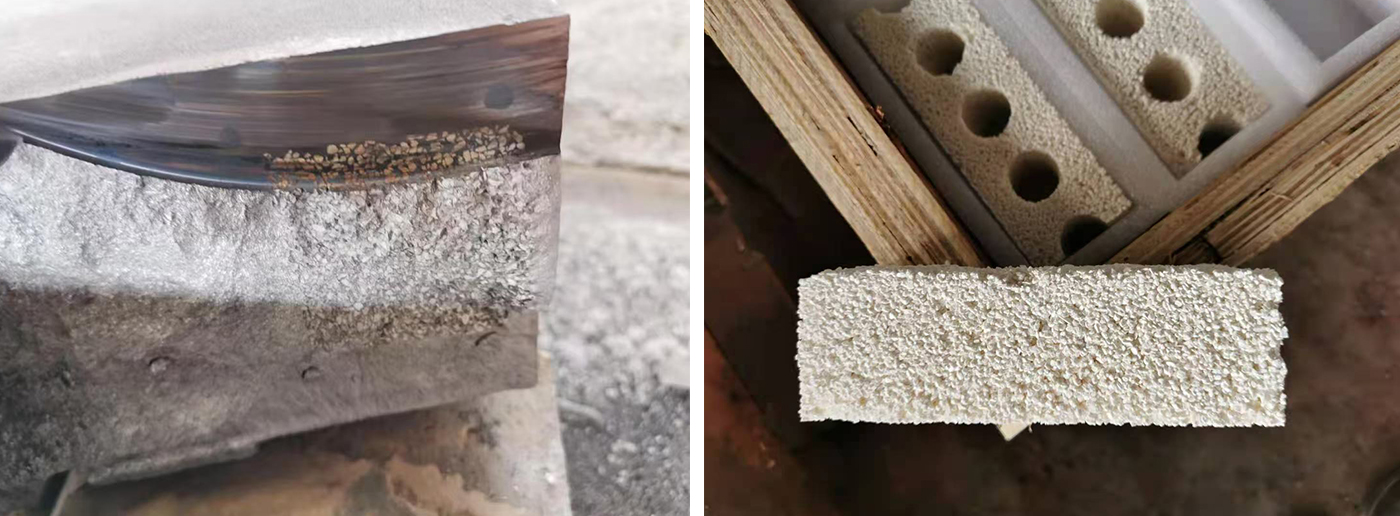
Metal matrix composites (MMCs) integrate the high strength and durability of a metallic matrix with the exceptional hardness of ceramic materials. The manufacturing process involves creating porous preforms from ceramic particles, into which molten metal is infiltrated, filling the interconnected ceramic network. A key aspect of this casting technique lies in effectively combining two materials with significantly different densities—steel at approximately 7.85 g/cm³ and ceramic ranging from 1 to 3 g/cm³—ensuring thorough infiltration and bonding.


This unique combination results in blow bars that exhibit outstanding wear resistance while maintaining high impact strength. Blow bars manufactured from these ceramic-based composites achieve a service life three to five times longer than those made from conventional martensitic steel.


Impact crusher liners

Related products

We are here for you!

For more information about any of our services, please feel free to contact us. Our team is always happy to provide information about our quality crusher parts.

Follow Us

Request a Quote

File Upload

Inquiry Now

We're sorry,our website is still growing.Please contact us directly for this product.

    We use cookies to enhance your user experience. For more information about the processing of personal date,please go to Privacy Policy.